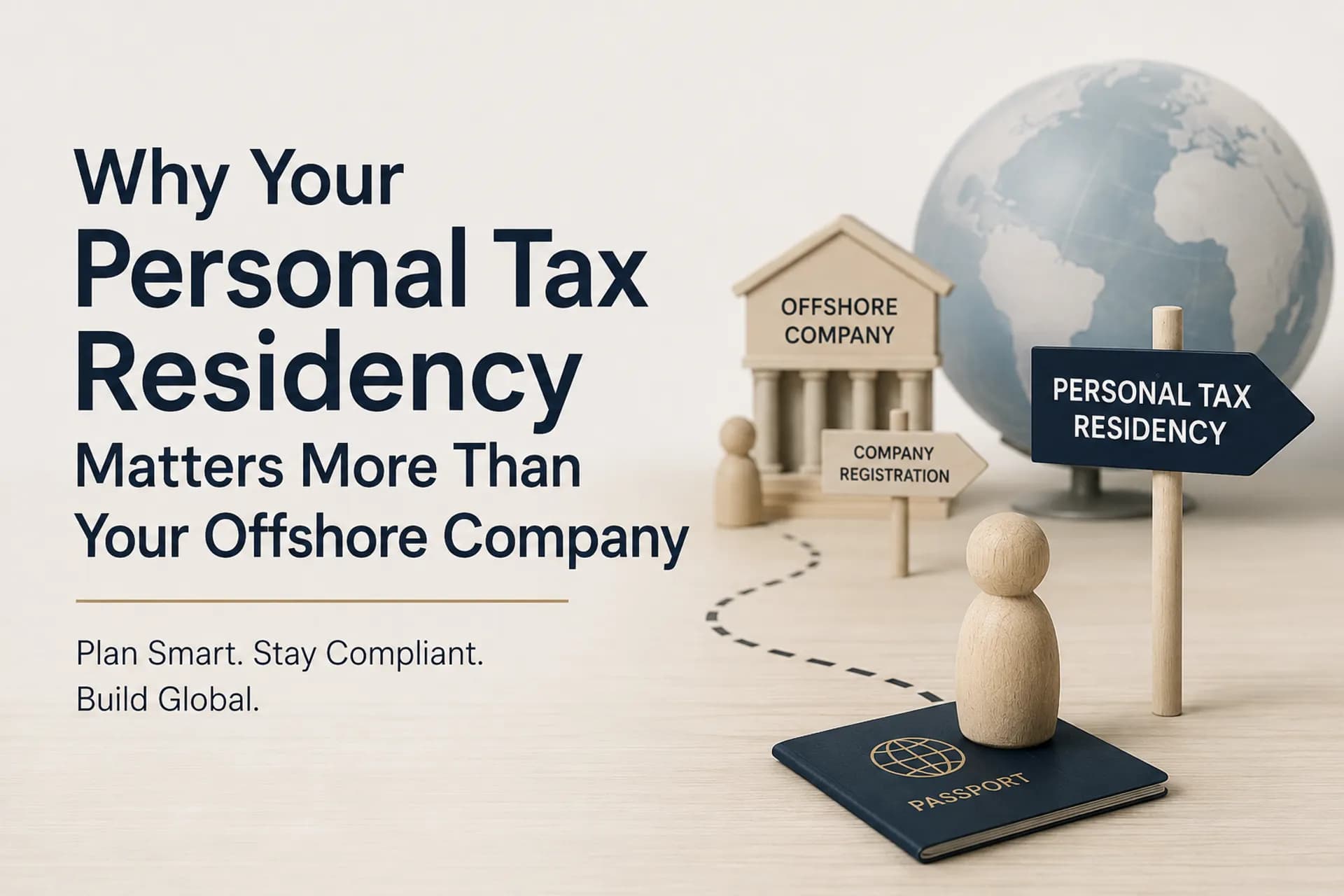

Your Personal Tax Residency Matters
The internet made international business look deceptively simple.
Open a company abroad.
Use an online bank.
Invoice clients internationally.
Pay lower taxes.
Done.
At least, that is how social media sells the story.
But in reality, international structuring is much more nuanced than most entrepreneurs initially understand. And one of the biggest misconceptions is believing that company registration alone determines your tax situation.
It does not.
Because while your company may be registered in one country, you as an individual still exist somewhere fiscally. And in many cases, your personal tax residency matters even more than the company itself.
The Mistake Many Entrepreneurs Realize Too Late
A founder opens a company in another jurisdiction because they heard it offers lower taxes or better banking.
Maybe it is the Netherlands. Maybe Dubai. Maybe Estonia or another international business hub.
But after incorporation, nothing really changes in their personal life.
They still live in the same country.
They still spend most of the year there.
They still manage the business from there.
Their family is there.
Their daily economic activity remains there.
From the perspective of tax authorities, this matters enormously.
Because modern taxation is no longer only about where a company exists on paper. Authorities increasingly analyze where the real management and real economic life actually happens.
And today, governments exchange financial information more aggressively than ever before.
Frameworks such as the OECD Common Reporting Standard (CRS) fundamentally changed international transparency. Banks, fintech platforms, and financial institutions now routinely share tax related information across borders.
The old offshore world of anonymity largely disappeared.
Your Lifestyle Often Defines Your Tax Residency
This is the part many digital entrepreneurs underestimate.
Tax residency is not determined only by paperwork or company certificates.
Very often, it is determined by your real life.
Where do you actually spend your time?
Where do you sleep most of the year?
Where is your family based?
Where do you manage your business from?
Where are your economic interests centered?
Many countries use the famous 183 day rule as a starting point, but reality is usually far more complex.
Some jurisdictions evaluate what is called your “center of vital interests.” Others focus on effective management, long term presence, or economic substance.
This becomes especially relevant for online entrepreneurs who believe remote work automatically makes them “tax free” or disconnected from local obligations.
In practice, modern tax systems became significantly more sophisticated.
International Structures Are About Much More Than Taxes
One of the biggest problems with online business content today is that everything gets reduced to aggressive tax optimization.
“Pay 0% tax.”
“Move offshore.”
“Escape the system.”
But serious international entrepreneurs eventually realize that sustainable structures are not built only around minimizing taxes.
They are built around:
- Compliance
- Banking stability
- International credibility
- Operational simplicity
- Asset protection
- Scalability
- Long term sustainability
There is a major difference between a structure that sounds exciting online and a structure that actually survives compliance reviews, banking checks, investor due diligence, and international growth.
Experienced founders understand this very quickly.
Why More Entrepreneurs Relocate Their Personal Residency
For many founders, international structuring eventually becomes personal as well.
Not only because of taxes, but because lifestyle and business become increasingly interconnected.
Entrepreneurs today are more mobile than ever before. They choose jurisdictions not only for taxation, but also for quality of life, international access, safety, banking infrastructure, and business friendliness.
This is why countries such as the United Arab Emirates, Portugal, Cyprus, and Malta continue attracting international entrepreneurs.
Not because they are “secret loopholes,” but because they actively position themselves as international business hubs.
Still, there is no universal solution.
A structure that works perfectly for one founder may be completely inefficient or even problematic for another depending on their nationality, existing residency, source of income, or future plans.
The Company and the Founder Cannot Be Separated
This is probably the most important thing international entrepreneurs need to understand.
A company structure should never be analyzed independently from the founder behind it.
For example, a Netherlands Holding structure may work extremely well for one entrepreneur while creating unnecessary complexity for another purely because of differences in personal tax residency.
The same company can produce completely different tax outcomes depending on who owns and manages it.
This is why serious international structuring always looks at the full ecosystem together:
- Corporate structure
- Personal tax residency
- Banking
- Compliance obligations
- International reporting
- Real economic substance
- Long term business plans
At Bizonaire, one of the most common mistakes we see is entrepreneurs focusing entirely on company registration while overlooking their personal fiscal position.
Ironically, that second layer is often the one that determines whether the structure truly works long term.
Final Thoughts
International business has never been more accessible through modern international company formation and global banking infrastructure.
You can open companies remotely, hire teams globally, work from anywhere, and operate internationally faster than ever before using modern company formation services, international banking, and remote operational structures.
But international compliance has also evolved dramatically.
The entrepreneurs who build sustainable structures today are usually not the ones chasing the most aggressive solutions.
They are the ones building structures that make sense operationally, legally, financially, and personally.
Because in modern international business, where your company is registered is only part of the equation.
Where you personally belong fiscally may matter even more.