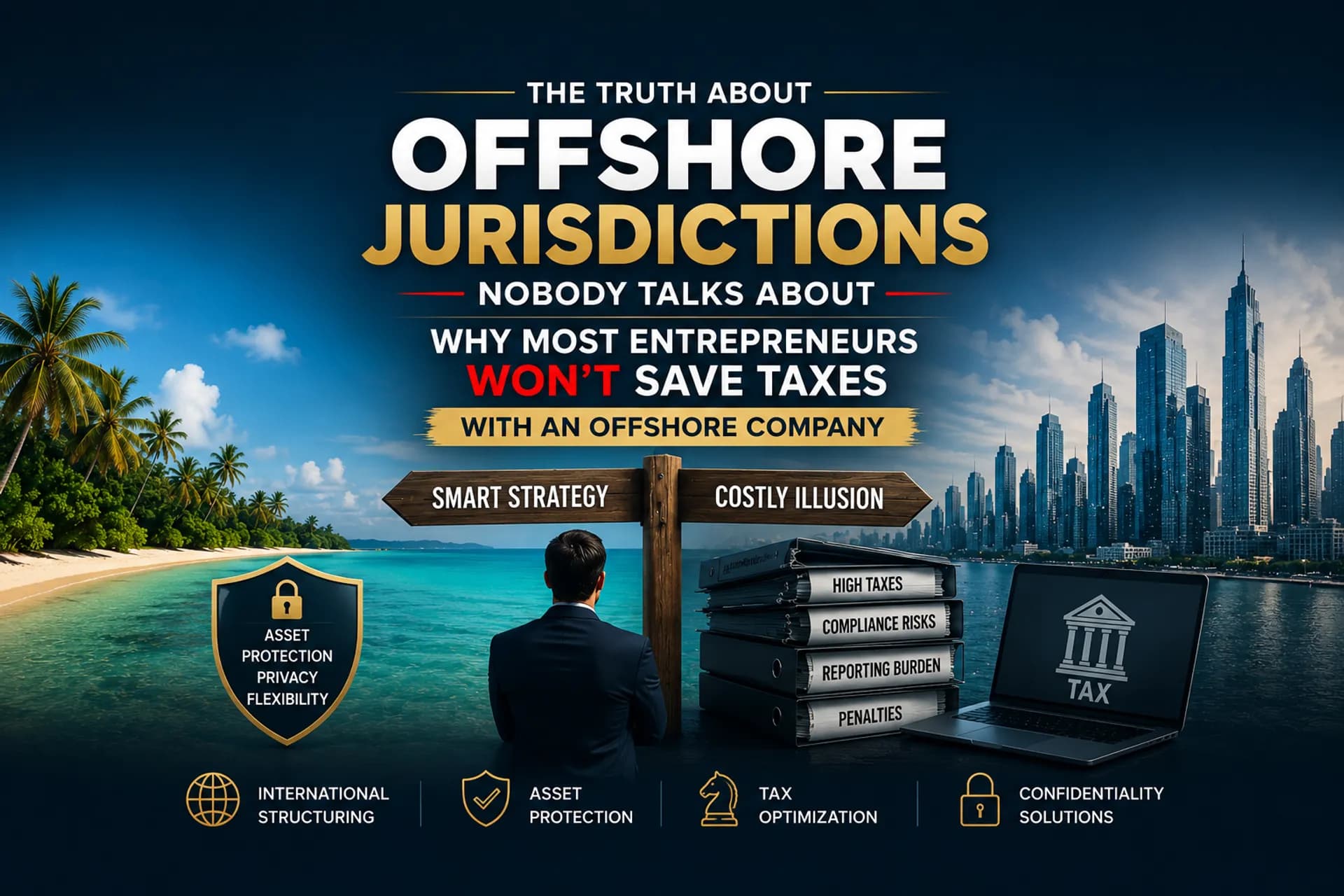

The Offshore Lie: Why Most Entrepreneurs Won’t Save Taxes with an Offshore Company
For decades, offshore jurisdictions have been marketed as the ultimate solution for entrepreneurs seeking lower taxes, privacy, and financial freedom.
Search online and you will find countless videos promising that a company in Dubai, Nevis, the British Virgin Islands, Belize, or another offshore jurisdiction can help you “legally pay zero tax.”
The reality is far more nuanced.
While offshore structures can be incredibly powerful when used correctly, most entrepreneurs misunderstand their purpose. In many cases, an offshore company alone will not reduce taxes at all. In some situations, it can even create additional reporting obligations, compliance costs, and legal risks.
Let’s separate fact from fiction.
The Myth: Open an Offshore Company and Stop Paying Taxes
The most common misconception is simple:
“I live in my home country, but if I open a company in an offshore jurisdiction, I will stop paying taxes.”
For most entrepreneurs, this is simply not how modern tax systems work.
Today, many countries tax individuals based on their tax residency, citizenship, or worldwide income. Tax authorities have become increasingly sophisticated in identifying foreign ownership structures, beneficial owners, and cross-border transactions.
Opening a company in a low-tax jurisdiction does not automatically eliminate your personal tax obligations.
The company may be offshore. You are not.
Why Offshore Jurisdictions Became So Popular
The offshore industry did not emerge by accident.
Historically, offshore jurisdictions offered several advantages:
- Low or zero corporate taxes
- Strong privacy protections
- Flexible company laws
- Faster incorporation processes
- Asset protection opportunities
- Political and economic diversification
These advantages remain relevant today.
The problem is that many entrepreneurs focus exclusively on the tax aspect while ignoring the other benefits that are often more valuable.
When Offshore Structures Actually Make Sense
Asset Protection
For business owners, investors, and high-net-worth individuals, protecting assets can be just as important as growing them.
Certain jurisdictions have developed sophisticated legal frameworks designed to protect assets from future creditors, frivolous lawsuits, and commercial disputes.
For example, properly structured trusts and holding entities can create additional layers of protection between personal assets and business risks.
For entrepreneurs operating in high-liability industries, this can be extremely valuable.
Privacy and Confidentiality
Many successful entrepreneurs prefer not to have every asset, company, or investment publicly connected to their personal name.
Offshore structures can provide a higher degree of confidentiality compared to many domestic jurisdictions.
This does not mean secrecy from banks, regulators, or tax authorities. It means reducing unnecessary public exposure.
For investors, business owners, and family offices, privacy remains a legitimate objective.
International Expansion
Many companies use offshore or international structures for operational reasons rather than tax reasons.
Examples include:
- Holding international intellectual property
- Managing global investments
- Expanding into new markets
- Centralizing ownership of multiple subsidiaries
- Simplifying international transactions
In these situations, the offshore structure supports business growth rather than tax avoidance.
The Reality About Tax Optimization
Here is the part that most offshore marketing campaigns conveniently ignore.
The biggest tax factor is usually not where your company is incorporated.
It is where you personally live and where you are considered tax resident.
A German entrepreneur living in Germany will usually remain subject to German tax rules, even if their company is incorporated elsewhere.
A French entrepreneur living in France will generally remain subject to French tax obligations.
A U.S. citizen living in New York may continue to have extensive U.S. tax obligations regardless of where the company is incorporated.
This is why many wealthy individuals who genuinely reduce their tax burden often combine business structuring with residency planning.
The company structure alone is rarely the complete solution.
The Difference Between Tax Optimization and Tax Evasion
This distinction is critical.
Tax optimization means structuring your affairs within the framework of the law to reduce unnecessary tax exposure.
Tax evasion means deliberately hiding income, assets, or ownership from tax authorities.
Professional international tax planning focuses on optimization, compliance, and risk management.
Any structure that depends entirely on remaining undiscovered is not a strategy. It is a gamble.
The Offshore Strategy That Actually Works
The most successful international entrepreneurs rarely ask:
“Which offshore jurisdiction pays zero tax?”
Instead, they ask:
- Where should I establish tax residency?
- Where should my company operate?
- Where should intellectual property be held?
- Which jurisdiction offers the best legal protection?
- Which structure supports future expansion?
- How do I remain compliant while minimizing unnecessary taxation?
Those questions lead to sustainable solutions.
Offshore Jurisdictions Are Not Dead. They Are Often Misunderstood.
Offshore structures remain powerful tools when used correctly.
They can provide:
- Asset protection
- Confidentiality
- International flexibility
- Efficient holding structures
- Cross-border investment opportunities
What they usually do not provide is a magical way to eliminate taxes while continuing to live and operate exactly as before.
The world has changed. Tax planning has become more sophisticated. Successful entrepreneurs understand that proper structuring is about combining jurisdictions intelligently rather than chasing the lowest headline tax rate.
Looking for Legitimate International Tax Optimization?
If your goal is to reduce taxes legally through international structuring, tax residency planning, holding companies, or operational restructuring, our team can help you evaluate the most suitable jurisdictions based on your personal circumstances and business objectives.
Book a consultation with Bizonaire and receive a tailored international structuring assessment designed around compliance, efficiency, and long-term growth.
Need Asset Protection or Confidential Ownership Structures?
If your primary objective is asset protection, privacy, succession planning, or international holding structures, we can help identify the jurisdictions and legal frameworks most appropriate for your needs.
Our specialists work with trusted partners worldwide to design compliant structures that balance protection, confidentiality, and operational flexibility.